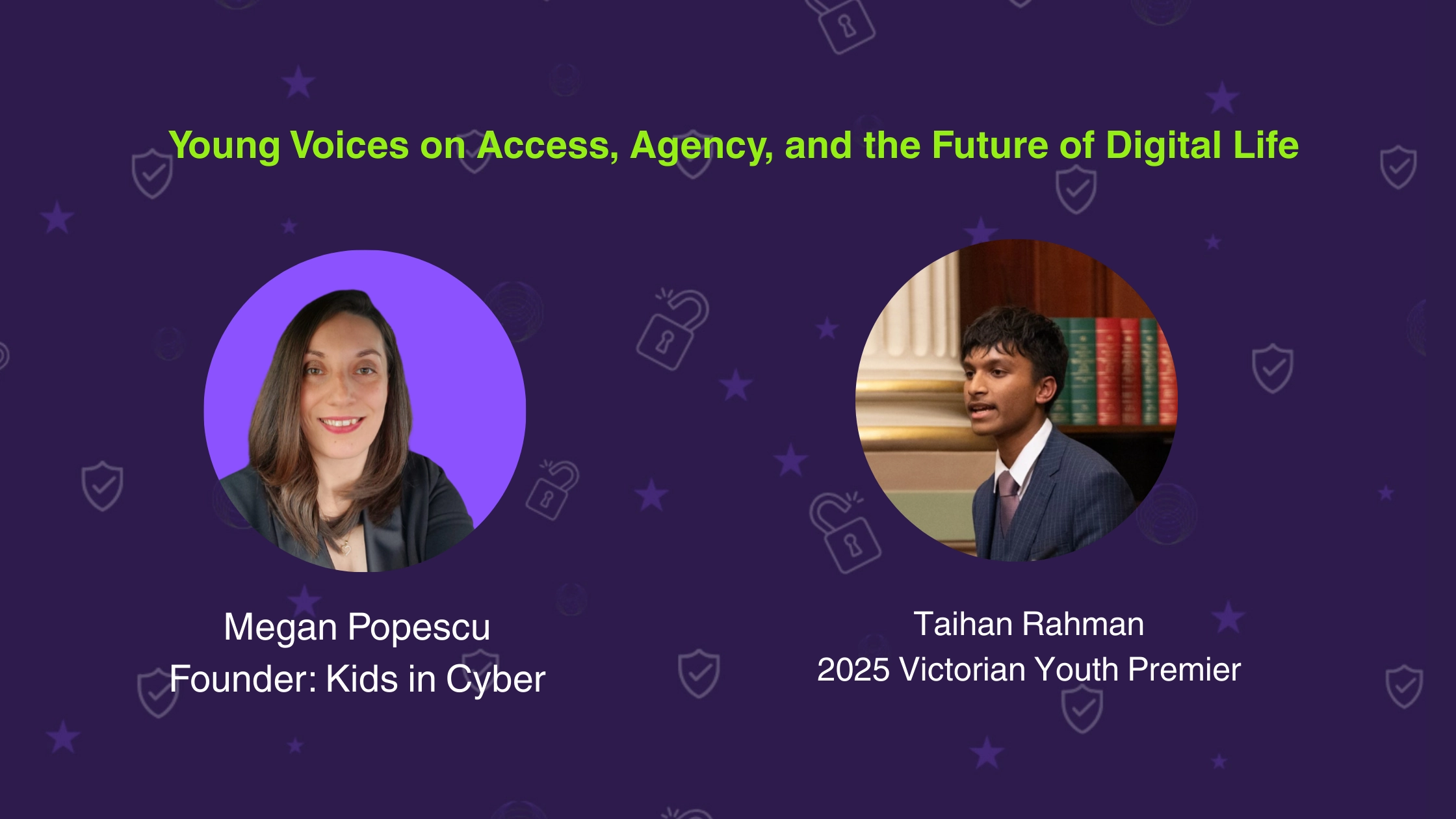
Today, as part of Conversations with Kids in Cyber, I spoke with Taihan Rahman about the Australian social media ban. What unfolded felt like a story, not a debate. It was a conversation that kept circling back to one question. If we remove young people from these spaces, what are we truly giving them instead?
Again and again, the Australian social media ban revealed gaps that policy has not yet answered.
Socialising Outside Social Media Is Happening, But at What Cost?
One part of the conversation that stayed with me was this idea that young people will simply socialise elsewhere. In theory, that sounds reasonable. Taihan acknowledged that young people are forming groups outside social media. However, the Australia social media ban often ignores the cost attached to those alternatives.
Sports clubs, creative programs, and transport all cost money. Even informal spaces often require resources that families do not have. As we discussed this, it became clear that an offline connection is not free. For many young people, the price tag alone becomes a barrier. Inclusion, therefore, becomes conditional.
When connection depends on income, exclusion quietly grows.
Removing Access Without Building Support
Another question kept resurfacing during our discussion. If we move young people away from social media, what support is actually in place? The Australian social media ban focuses on removal. It speaks far less about replacement. Taihan noted that many young people relied on social media for community, identity, and a sense of belonging. Taking that away without structured support leaves a void. Support cannot be theoretical. It needs to be visible, funded, and accessible. Otherwise, removal becomes abandonment.
We both agreed that policy must answer this honestly. What support exists right now? Who is it for? How do young people access it?
Mental Health Is Complex, Not a Single Cause
Mental health was one of the primary reasons cited for the Australian social media ban, and we spent time unpacking that. Taihan was firm. Framing social media as the cause of declining mental health is unfair. Mental health is layered, personal, and shaped by many factors. We did not dismiss harm. Social media can exacerbate anxiety, comparison, and pressure. That reality matters.
However, blaming one factor oversimplifies a complex issue. When mental health is reduced to a single cause, meaningful solutions are missed. Young people deserve nuance, not scapegoats.
What actually counts as social media?
At one point, we paused and asked a basic question. What counts as social media under the Australian social media ban? Platforms like TikTok and Instagram are restricted. Yet YouTube remains accessible. That contradiction stood out. YouTube includes Shorts, algorithm-driven content, comment sections, and engagement loops. In practice, it can closely mirror traditional social media.
If the concern is mental health and algorithmic influence, why is one platform treated differently? Young people notice these inconsistencies immediately. This grey area weakens trust in the policy itself.
Preparing young people or just delaying access?
Another question sat at the centre of our conversation. If access is delayed, what preparations are being made? Under the Australian social media ban, young people are eventually given access at sixteen. That raises an important issue. Is a sixteen-year-old automatically more equipped than a fourteen or fifteen-year-old? Taihan questioned that assumption.
Without education, guidance, and digital literacy, age alone changes very little. Delaying access without preparation simply postpones the same risks. We spoke about the need for meaningful education before access begins. Preparation should not start at sixteen. It should start much earlier.
When Connection Is Removed, Something Fills the Space
I shared a concern that keeps surfacing. When a connection is removed, something takes its place. For some young people affected by the Australian social media ban, that replacement may be AI chatbots. These tools offer conversation without judgment or barriers.
They may reduce loneliness temporarily. However, they are not a community. They do not replace human belonging. If policy removes one outlet, it must consider what young people turn to next.
Final Reflection
The Australian social media ban is not just about platforms. It is about cost, support, readiness, and trust.
Socialising offline is happening, but it is not equally accessible. Mental health matters, but it cannot be simplified. Delayed access means little without preparation.
If the goal is to protect young people, then support must come first. Most importantly, young people must remain part of the conversation, not the subject of it.