What the Research Is Showing
If a child becomes irritable or unsettled after watching certain videos, it is often dismissed as ‘too much screen time’. But emerging research suggests the issue may be more specific than that. It is not just how long children are spending on screens. It is what they are watching, and how that content is constructed.
Recent analysis of popular children’s videos shows a clear shift in how content is designed to hold attention. Compared with traditional broadcast television, many online videos aimed at young children are faster, more visually intense, and more fragmented in structure. This has implications for how children process what they see.
The pace of content has changed
One of the clearest differences is the speed at which content moves. Traditional children’s programmes tend to use slower editing and more stable visuals. Scenes last longer, the camera is often fixed, and movement is used selectively to guide attention. By contrast, many online videos cut rapidly, sometimes every one to two seconds. Movement is constant, not just from characters but from the camera itself. Backgrounds shift, objects move, and the visual field rarely settles.
From a developmental perspective, this matters. Young children process information more slowly than adults. They rely on repetition, consistency, and time to make sense of what they are seeing. When content moves too quickly, it reduces the opportunity for that processing to take place.
Attention is being captured, not guided
Research into early brain development shows that humans are wired to respond to movement and sudden visual change. It is an automatic response that does not require conscious effort. In children’s television, this response was used deliberately. Movement was introduced at key moments to draw attention to something important in the story. In much of today’s online content, that same mechanism is used continuously.
Frequent visual shifts, rapid cuts, and changes in brightness or colour all trigger what researchers describe as involuntary attention capture. When this happens repeatedly, it keeps the viewer engaged, but it also places the brain in a heightened state of alertness.
The impact on behaviour
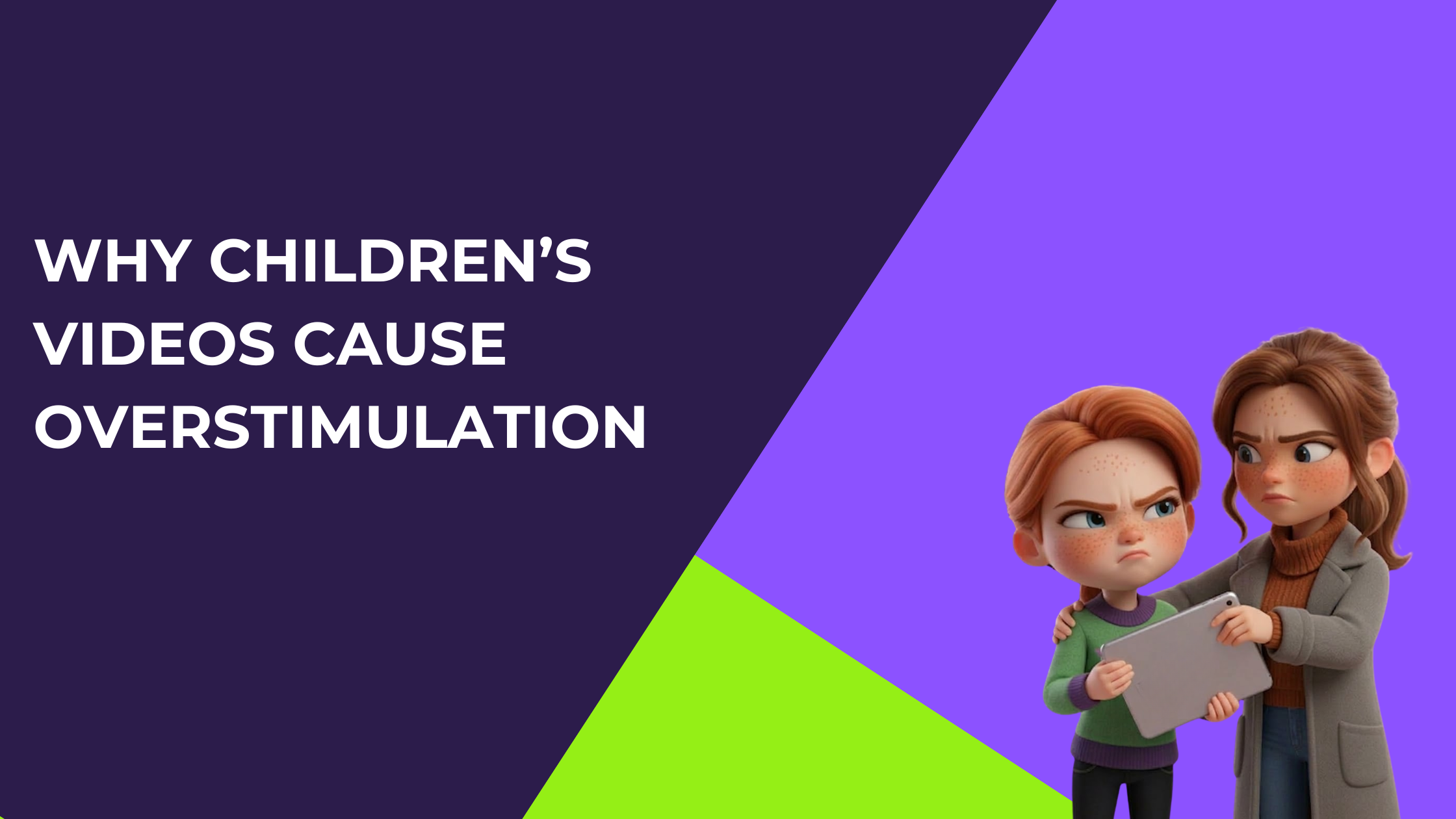
This heightened state is linked to activation of the sympathetic nervous system, often referred to as the body’s fight or flight response. In practical terms, this means a child is not simply watching passively. Their body is being stimulated to stay alert. When the video ends, that level of arousal does not immediately disappear. For some children, this can present as irritability, restlessness, or difficulty transitioning to another activity.
This aligns with what many parents report anecdotally, and is increasingly being explored in research. Studies have also begun to link fast-paced content with challenges in attention, self-regulation, and executive function, even when the content itself is educational in intent.
Structure and continuity
Another difference lies in how content is organised. Traditional programmes follow a single narrative. Characters are introduced gradually and reappear throughout the episode. This allows children to build familiarity, recall information, and follow a sequence.
On platforms like YouTube, viewing is often made up of multiple short videos watched back-to-back. Each introduces new characters and settings, with little continuity between them. This constant switching places additional demand on a child’s attention and memory. There is less opportunity to follow a storyline over time, and fewer cues to support understanding.
What this means for adults
The current discussion around children and screens often focuses on limits: how long is too long. That question still matters, but it is not the only one. The nature of the content itself needs to be considered. Pace, visual intensity, and structure all play a role in how a child experiences what they are watching. Not all screen content is the same, and not all viewing experiences have the same effect.
For parents and educators, this creates a more complex picture. It is no longer just about reducing screen time, but about understanding the environments children are engaging with.
A changing landscape
Children’s media has changed rapidly. The systems that once shaped content around developmental needs are no longer the primary influence on what children watch. Instead, much of today’s content is shaped by what holds attention. The research is still developing, and there are important nuances in how different types of content affect different children. But there is increasing recognition that the design of content itself is part of the conversation.
If children appear unsettled after watching certain videos, it may not simply be a question of too much screen time. It may be a reflection of how that content is designed to be experienced.